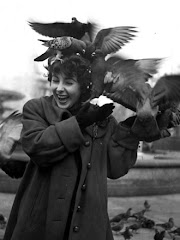
If you´re a city dweller, chances are you see them everyday - strolling down the sidewalk with their friends, having lunch at a local cafe, or just hanging out in the park. But for as much as we share with our urban lifestyles, few animals are as misunderstood or as maligned as the humble pigeon. They are such a part of life around the world that it´s not so strange to hear otherwise sensible animal-lovers refer to pigeons as ¨rats with wings,¨ offering nary a word on their unique history or simple beauty. Perhaps the time is nigh to better understand our feathered city-dwelling neighbors who´ve been pigeonholed too long.
Of the 309 different species of pigeon, Rock Pigeons are the ones most acquainted with urban life - but despite the advantage they take of human infrastructure, there was a time that even they had to rough it. In fact, the species has been coolly strutting around for about 20 million years, long before the advent of bread crumbs or bronze statue perches. In the wild, the animals´ original habitat was on the rocky cliff sides of Africa, Asia, Europe, and the Middle East.
Although nowadays many people aren´t big fans of the birds, one reason they´re so numerous today is that once pigeons were highly regarded. Between 5,000 to 10,000 years ago, the birds were first captured and raised by humans - primarily for food, but also to carry messages over long distances. The animals´ feathers, too, were prized for their attractive feathers and unique coloring. Selective breeding in centuries past is one reason that pigeon color patterns are so varied today.
Early on, humans took note of pigeons´ uncanny sense of finding their way home and employed them with carrier duties, giving rise to Messenger Pigeons. Even Julius Caesar took advantage of these clever birds, using pigeons to send war reports from the front line. The birds were used in a similar capacity for centuries, before radio and telephone communication made them pretty much obsolete. But some pigeons enlisted to aid in war efforts turned out to be quite brave as well.
One popular story from World War I surrounds a pigeon named Cher Ami, stationed with American troop fighting on the front-line in France. When soldiers from New York´s 77th Division found themselves under siege from friendly-fire, they tried sending a note via Messenger Pigeon to inform the other troops that they weren´t the enemy, but the bird was shot down. Another bird was sent, but it too was killed. In a desperate third attempt, the soldiers tied a note to Cher Ami: "Our artillery is dropping a barrage on us. For heaven's sake, stop it!" The bird was shot too, several times, but managed to keep flying until the message was delivered. For this bravery, Cher honors back home. His body can be seen at the Smithsonian Institute.
Despite occasionally being honored for their service in war-time, pigeons as a symbol are have quite a different reputation under their more flattering pseudonym - the dove.
But even the humble pigeon, as a city-dweller, doesn´t get credit where credit may be due, in part because of certain misconceptions that the birds spread disease to humans. Although they can carry parasites and viruses, like West Nile, pigeons are thought not to be transmitters of it. Still, many urban areas have gone to great lengths to dampen their presence about town.
London´s Trafalgar Square was once famed for its vibrant pigeon population, considered a tourist attraction in and of itself. In 2003, however, the city´s mayor banned the sale of pigeon food, hoping the birds would move on. Activist groups, like Save the Trafalgar Square Pigeons, sought to keep the birds around and continued to feed them anyways.
Other cities have taken a more drastic approach to combating pigeons, even resorting to the use of poisons, though the practice isn´t preferred since it can pose a threat to other animals too. Selectively removing fertilized eggs from specially installed coops and even birth control are amongst the other creative, slightly more humane solutions to too many pigeons in cities across the world.
It´s only been a few centuries since the birds were first brought to the Americas, but now the Rock Pigeon can be found in nearly every city in the world with a population numbering in the tens of millions. Some other pigeon species, however, haven´t fared quite as well. Eleven species of pigeon have gone extinct - like the famous over hunted Dodo bird - while several others are considered threatened.
City pigeons, though clearly outside of their natural habitat (just as we are, I suppose), are animals of unique talent a beauty - even if they may eat our refuse and occasionally sully our memorialized forebearers. Even pigeon loving groups have been established, like Cornell University´s Project Pigeon Watch, aiming to redefine how the world looks at the bird.
Who knows, with an open mind and little understanding, perhaps one day the pigeon will be thought of with a bit more respect, and even adoration. You´ve got to admit, they are pretty darn coo.
Monday, August 30, 2010
Friday, August 6, 2010
Pigeon Racing is a Cruel Blood Sport
August 4, 2010
Pigeon racing is a cruel blood sport
By Times Wire
Thank you for exposing the pigeon racing industry for what it is - a cruel and possibly illegal enterprise operating under the guise of an innocent hobby.
In response to Zig Vanderwall's denial of culling (killing) racing pigeons by wringing their necks, and his statement that "I don't know where (PETA) got that," I could offer many sources, but here's just one: A commonly used Gulfcoast Homing Pigeon Club sponsor's reference book states that "in most cases, birds not up to standards are culled." It describes the killing as a "necessary evil" to maintain the quality of the racing pigeons, and notes that the most common method of doing this is by "wringing the neck."
This aspect aside, many birds are killed when they have no choice but to race the hundreds of miles back to their lofts and mates through storms or are attacked by predators en route. If they must land due to injury or exhaustion, they can starve to death because they were born in captivity and do not know how to fend for themselves.
The county commissioners are in a unique position to ensure that the restrictions on keeping pigeons are kept and enforced, and to limit the number of birds exposed to this violent blood sport.
Jenny Lou Browning
People for the Ethical Treatment of Animals (PETA), Panama City
Pigeon racing is a cruel blood sport
By Times Wire
Thank you for exposing the pigeon racing industry for what it is - a cruel and possibly illegal enterprise operating under the guise of an innocent hobby.
In response to Zig Vanderwall's denial of culling (killing) racing pigeons by wringing their necks, and his statement that "I don't know where (PETA) got that," I could offer many sources, but here's just one: A commonly used Gulfcoast Homing Pigeon Club sponsor's reference book states that "in most cases, birds not up to standards are culled." It describes the killing as a "necessary evil" to maintain the quality of the racing pigeons, and notes that the most common method of doing this is by "wringing the neck."
This aspect aside, many birds are killed when they have no choice but to race the hundreds of miles back to their lofts and mates through storms or are attacked by predators en route. If they must land due to injury or exhaustion, they can starve to death because they were born in captivity and do not know how to fend for themselves.
The county commissioners are in a unique position to ensure that the restrictions on keeping pigeons are kept and enforced, and to limit the number of birds exposed to this violent blood sport.
Jenny Lou Browning
People for the Ethical Treatment of Animals (PETA), Panama City
Labels:
pigeon racing,
pigeons
Tuesday, July 27, 2010
Pigeon Population Decline with OvoControl P
Pigeon population problems pooping out?
June 9, 2008
In today's This Week Ahead column, we catch up on what's happening in Hollywood--not with celebrities but with pigeons:
How have the efforts to shrink the pigeon population in Hollywood using birth control gone since announcing it last July?
Since August, some of the area's estimated 5,000 pigeons have been eating pill-shaped kibble known as OvoControl P from feeders on rooftops, making Hollywood the first area to try the contraceptive since it was given state approval in late July.
About 300 pigeons flock every morning at daybreak to eat up the contraceptive kibble, which contains nicarbazin, an ingredient that stops an egg from developing. OvoControl P has been registered with the state Department of Pesticide Regulation and the U.S. Environmental Protection Agency, and is approved by PETA and the Humane Society.
Laura Dodson, president of the Argyle Civic Assn., a neighborhood group leading the effort called Citizen Pigeon, said that they raised enough money from local businesses and residents -- over $50,000 -- to install five rooftop automatic feeders. They’ve also installed cameras to monitor the birds eating online.
After four months, the 438 pigeon regulars in one spot dropped to just below 40. Some through attrition, but pigeons are "just having less babies now," Dodson said.
The original date to reduce the pigeon population by 50% was 2012, but Dodson said that pest control and wildlife officials think it could happen within the next two years.
The pigeons are disliked in the area, currently under millions of dollars in renovation efforts, because of the messy droppings.
Italy, though, is taking a different approach on cracking down on the birds.
--Francisco Vara-Orta
June 9, 2008
In today's This Week Ahead column, we catch up on what's happening in Hollywood--not with celebrities but with pigeons:
How have the efforts to shrink the pigeon population in Hollywood using birth control gone since announcing it last July?
Since August, some of the area's estimated 5,000 pigeons have been eating pill-shaped kibble known as OvoControl P from feeders on rooftops, making Hollywood the first area to try the contraceptive since it was given state approval in late July.
About 300 pigeons flock every morning at daybreak to eat up the contraceptive kibble, which contains nicarbazin, an ingredient that stops an egg from developing. OvoControl P has been registered with the state Department of Pesticide Regulation and the U.S. Environmental Protection Agency, and is approved by PETA and the Humane Society.
Laura Dodson, president of the Argyle Civic Assn., a neighborhood group leading the effort called Citizen Pigeon, said that they raised enough money from local businesses and residents -- over $50,000 -- to install five rooftop automatic feeders. They’ve also installed cameras to monitor the birds eating online.
After four months, the 438 pigeon regulars in one spot dropped to just below 40. Some through attrition, but pigeons are "just having less babies now," Dodson said.
The original date to reduce the pigeon population by 50% was 2012, but Dodson said that pest control and wildlife officials think it could happen within the next two years.
The pigeons are disliked in the area, currently under millions of dollars in renovation efforts, because of the messy droppings.
Italy, though, is taking a different approach on cracking down on the birds.
--Francisco Vara-Orta
Labels:
Hollywood CA,
OvoControl P,
PETA,
pigeon population control
Monday, July 5, 2010
Passenger Pigeons Deserved Better Fate
The last passenger pigeon passed on in 1914. He lived in a zoo in Cincinnati.
That’s pretty pathetic, considering that, at one time, their numbers were estimated to be in the billions. This particular breed of squab was fairly large, at 17 inches length. And, apparently, tasty. When the Europeans arrived, the passenger pigeons’ days were numbered. They were slaughtered by the thousands. For a time men actually made a living traveling to pigeon breeding grounds and killing them for market. By the mid-1800s they were thinning out. By 1914 they were gone.
The eastern Indians — ours included — were fond of these passenger pigeons as well. Sometimes their winter hunting camps were aimed as much as putting them near the pigeons’ nesting grounds as any other game. They used the pigeons for meat and even as a kind of butter.
Explorer John Lawson wrote about his first experiences with passenger pigeons:
“(They) were so numerous in these Parts, that you might see many Millions in a Flock; they sometimes split off the Limbs of stout Oaks, and other Trees, upon which they roost o’ Nights. You may find several Indian Towns… that have more than 100 Gallons of Pigeons Oil, or Fat; they using it with Pulse, or Bread, as we do Butter… The Indians take a Light, and go among them in the Night, and bring away some thousands, killing them with long Poles, as they roost in the Trees. At this time of the Year, the Flocks, as they pass by, in great measure, obstruct the Light of the day.”
You’ve got to admit, that’s a lot of pigeons. The ground beneath the trees, where they roosted, was covered by a half-foot layer of dung. Think of parking your newly-waxed car in the shade and discovering that the next morning!
And, Lawson avowed, this was only a small portion of their population: in 1701, when he was exploring the westernmost part of the Carolinas, he saw “infinite Numbers of these Fowl…(that) would fly by us in such vast Flocks, that they would be near a Quarter of an Hour, before they were all pass’d by; and as soon as that Flock was gone, another would come; and so successively one after another, for great part of the Morning.”
It is sad that spectacles like this can only be experienced through history — and that we are the reason this is so.
Sun Journal article
Bill Hand can be contacted at newbernhistory@yahoo.com.
That’s pretty pathetic, considering that, at one time, their numbers were estimated to be in the billions. This particular breed of squab was fairly large, at 17 inches length. And, apparently, tasty. When the Europeans arrived, the passenger pigeons’ days were numbered. They were slaughtered by the thousands. For a time men actually made a living traveling to pigeon breeding grounds and killing them for market. By the mid-1800s they were thinning out. By 1914 they were gone.
The eastern Indians — ours included — were fond of these passenger pigeons as well. Sometimes their winter hunting camps were aimed as much as putting them near the pigeons’ nesting grounds as any other game. They used the pigeons for meat and even as a kind of butter.
Explorer John Lawson wrote about his first experiences with passenger pigeons:
“(They) were so numerous in these Parts, that you might see many Millions in a Flock; they sometimes split off the Limbs of stout Oaks, and other Trees, upon which they roost o’ Nights. You may find several Indian Towns… that have more than 100 Gallons of Pigeons Oil, or Fat; they using it with Pulse, or Bread, as we do Butter… The Indians take a Light, and go among them in the Night, and bring away some thousands, killing them with long Poles, as they roost in the Trees. At this time of the Year, the Flocks, as they pass by, in great measure, obstruct the Light of the day.”
You’ve got to admit, that’s a lot of pigeons. The ground beneath the trees, where they roosted, was covered by a half-foot layer of dung. Think of parking your newly-waxed car in the shade and discovering that the next morning!
And, Lawson avowed, this was only a small portion of their population: in 1701, when he was exploring the westernmost part of the Carolinas, he saw “infinite Numbers of these Fowl…(that) would fly by us in such vast Flocks, that they would be near a Quarter of an Hour, before they were all pass’d by; and as soon as that Flock was gone, another would come; and so successively one after another, for great part of the Morning.”
It is sad that spectacles like this can only be experienced through history — and that we are the reason this is so.
Sun Journal article
Bill Hand can be contacted at newbernhistory@yahoo.com.
Labels:
extinction,
passenger pigeons
Wednesday, May 12, 2010
Humane Society of the US Supports Pigeon Birth Control
As the pigeon population steadily is declining on its own most likely due to extreme difficulties pigeons are facing surviving on our planet, the HSUS is in full support of the birth control drug for pigeons OvoControl P. The following article is in their newsletter:
‘Birth Control’ for Pigeons Now Available Without a Prescription
EPA reclassifies OvoControl P® as general-use
WASHINGTON — The Humane Society of the United States praised the recent decision by the Environmental Protection Agency to remove the "restricted-use" classification for OvoControl P, a promising birth control agent for use in pigeons.
"We are extremely pleased with the Environmental Protection Agency's decision to ease restrictions on OvoControl P," said John Hadidian, director of Urban Wildlife Programs for The HSUS. "General-use approval will make OvoControl P more readily available to communities and businesses that want to control pigeon populations humanely and effectively."
OvoControl P is an edible pellet treated with nicarbazin, a chemical that effectively reduces egg hatching rates in birds when used in combination with exclusion and other humane measures. It was originally registered by the EPA in 2008 as a "restricted-use" product, a designation that limited the sale and use of the product to licensed applicators only.
The new classification means that it will no longer be necessary to have a special license to purchase and use OvoControl P. OvoControl is also registered for use in Canada geese and Muscovy ducks under the more stringent label restrictions.
The HSUS' Wild Neighbors program promotes nonlethal solutions to conflicts between people and wildlife. For many years, pigeons have been subject to lethal control through poisoning, trapping, shooting or other inhumane methods. The HSUS supports the use of birth control technologies as a way to humanely control animal populations and decrease the likelihood of conflicts.
OvoControl is available through distributors or directly from the manufacturer, Innolytics, LLC. Visit ovocontrol.com for more details. Click here for more information from The HSUS on solving problems with pigeons.
‘Birth Control’ for Pigeons Now Available Without a Prescription
EPA reclassifies OvoControl P® as general-use
WASHINGTON — The Humane Society of the United States praised the recent decision by the Environmental Protection Agency to remove the "restricted-use" classification for OvoControl P, a promising birth control agent for use in pigeons.
"We are extremely pleased with the Environmental Protection Agency's decision to ease restrictions on OvoControl P," said John Hadidian, director of Urban Wildlife Programs for The HSUS. "General-use approval will make OvoControl P more readily available to communities and businesses that want to control pigeon populations humanely and effectively."
OvoControl P is an edible pellet treated with nicarbazin, a chemical that effectively reduces egg hatching rates in birds when used in combination with exclusion and other humane measures. It was originally registered by the EPA in 2008 as a "restricted-use" product, a designation that limited the sale and use of the product to licensed applicators only.
The new classification means that it will no longer be necessary to have a special license to purchase and use OvoControl P. OvoControl is also registered for use in Canada geese and Muscovy ducks under the more stringent label restrictions.
The HSUS' Wild Neighbors program promotes nonlethal solutions to conflicts between people and wildlife. For many years, pigeons have been subject to lethal control through poisoning, trapping, shooting or other inhumane methods. The HSUS supports the use of birth control technologies as a way to humanely control animal populations and decrease the likelihood of conflicts.
OvoControl is available through distributors or directly from the manufacturer, Innolytics, LLC. Visit ovocontrol.com for more details. Click here for more information from The HSUS on solving problems with pigeons.
Labels:
HSUS,
pigeon population control
Monday, March 22, 2010
Mike Tyson Pigeon Racing Show Ruffles PETA's Feathers
NEW YORK — An animal welfare group wants New York City prosecutors to investigate Mike Tyson's reality television show about pigeon racing.
People for the Ethical Treatment of Animals says the Brooklyn-based show is cruel to animals and its races could involve illegal gambling.
The show will follow Tyson as he competes in pigeon races. The former world heavyweight champion has raised pigeons all his life but is a racing rookie.
The show airs next year on Animal Planet. A spokeswoman says there have never been plans for wagering on the races. She says the pigeons will be "cherished and respected by their owners," including Tyson.
PETA sent a letter dated March 18 to the Brooklyn district attorney's office requesting an investigation.
District attorney spokesman Jonah Bruno says the office is looking into the allegations.
additional link (added 3/29/10)
NEW YORK — An animal welfare group wants New York City prosecutors to investigate Mike Tyson's reality television show about pigeon racing.
People for the Ethical Treatment of Animals says the Brooklyn-based show is cruel to animals and its races could involve illegal gambling.
The show will follow Tyson as he competes in pigeon races. The former world heavyweight champion has raised pigeons all his life but is a racing rookie.
The show airs next year on Animal Planet. A spokeswoman says there have never been plans for wagering on the races. She says the pigeons will be "cherished and respected by their owners," including Tyson.
PETA sent a letter dated March 18 to the Brooklyn district attorney's office requesting an investigation.
District attorney spokesman Jonah Bruno says the office is looking into the allegations.
additional link (added 3/29/10)
Labels:
cruelty to animals,
Mike Tyson,
PETA,
pigeon racing
Saturday, March 6, 2010
Pigeons Beat Humans at Solving Puzzle
Birds adept and solving 'Monty Hall problem' named after game show host
By Charles Q. Choi
Pigeons might do better than humans at game shows, at least on "Let's Make A Deal."
These new findings — involving the pigeons superior ability to solve a perplexing statistical problem — might in turn shed light on why humans are bad at solving certain kinds of problems, scientists added.
The so-called Monty Hall problem is a well-known puzzle named after the original host of the game show "Let's Make A Deal," who presented contestants with three doors, one of which held a prize, the other two only goats. The prize and the goats were placed randomly behind the doors beforehand, and stayed where they were throughout. After the contestant made a guess, Monty Hall would always open one of the remaining doors that he knew did not contain the prize. The player was then always given the option of staying with their initial guess or switching to the other unopened door.
Most people opted to stay with their initial guess, despite the fact that switching actually doubled the chances of winning.
To see why the apparently illogical choice of switching is actually better, one must understand that before the host opened one of the three doors, the contestant did not know the location of the prize, and thus when he or she chose a door, the contestant had a 1-in-3 chance of being right. That does not change even after the host opened a door. If the probability of the first door the contestant chose remained the same, and there were only two doors left, that meant the remaining unopened door must have had a 2-in-3 chance of being right — that is, it had twice the chance of holding the prize.
The fact that people do badly at this problem is true across cultures, including Brazil, China, Sweden and the United States. Indeed, when the Monty Hall problem appeared in the "Ask Marilyn" column in Parade magazine along with an explanation of the solution, the columnist received some 10,000 letters, 92 percent of which disagreed with her solution. This failing holds true even of many statisticians and mathematicians who should know better, including Paul Erdos, perhaps the most prolific mathematician in history.
Pigeons know better
To shed light on why humans often fall short of the best strategy with this kind of problem, scientists investigated pigeons, which often perform quite impressively on tasks requiring them to estimate relative probabilities, in some cases eclipsing human performance. Other animals do not always share the same biases as people, and therefore might help provide explanations for our behavior.
Scientists tested six pigeons with an apparatus with three keys. The keys lit up white to show a prize was available. After the birds pecked a key, one of the keys the bird did not choose deactivated, showing it was a wrong choice, and the other two lit up green. The pigeons were rewarded with bird feed if they made the right choice.
In the experiments, the birds quickly reached the best strategy for the Monty Hall problem — going from switching roughly 36 percent of the time on day one to some 96 percent of the time on day 30.
On the other hand, 12 undergraduate student volunteers failed to adopt the best strategy with a similar apparatus, even after 200 trials of practice each.
Why people don't get it
One possible reason people are worse than pigeons at the Monty Hall problem might be due to how people learn.
Past research with university students found they almost universally believed that staying and switching were equally likely to win, while younger students believed this less. Only in the youngest group tested — a bunch of 8th graders — did a significant although small fraction of students figure out switching was the best strategy. It may be that education leads people to acquire ways of thinking that, while efficient, can interfere with certain kinds of performance.
"During 'education,' which I would take to encompass not just formal education, but also one's general life experience, we acquire heuristics — rules of thumb that, either consciously or unconsciously, allow us to respond to a complex world quickly," said researcher Walter Herbranson, a comparative psychologist at Whitman College in Walla Walla, Washington. "But while these heuristics are fast and generally accurate, they're not correct 100 percent of the time."
The scientists propose the curious difference between pigeon and human behavior might be rooted in the difference between classical and empirical probability. In classical probability, one tries to figure out every possible outcome and make predictions without collecting data. In empirical probability, one makes predictions after tracking outcomes over time.
Pigeons likely use empirical probability to solve the Monty Hall problem and appear to do so quite successfully.
"Different species often find very different solutions to the same problems," Herbranson said. "We humans have ways of tackling probability-based problems that generally work pretty well for us, the Monty Hall dilemma being one notable exception. Pigeons apparently have a different approach, one that just happens to be better suited to the Monty Hall dilemma."
Empirical probability is a slower, less elegant, brute-force method that can be tricked by the kind of random fluctuations seen in real data, Herbranson said, but it doesn't employ any mental rules of thumb that can lead to traps such as the Monty Hall problem. In a similar way, the visual systems we depend on to quickly make sense of the world around us can lead to our susceptibility to visual illusions, he added.
Indeed, the aforementioned mathematician Paul Erdos demonstrated the power of empirical probability nicely as well. According to his biography, Erdos refused to accept the explanations of colleagues for the correct solution, and was eventually convinced only after he was shown a simple computer simulation than ran the problem hundreds of times. In other words, "after Erdos approached the problem like a pigeon, he was able to embrace the right answer," Herbranson said.
Herbranson and his colleague Julia Schroeder detailed their findings in the February issue of the Journal of Comparative Psychology.
By Charles Q. Choi
Pigeons might do better than humans at game shows, at least on "Let's Make A Deal."
These new findings — involving the pigeons superior ability to solve a perplexing statistical problem — might in turn shed light on why humans are bad at solving certain kinds of problems, scientists added.
The so-called Monty Hall problem is a well-known puzzle named after the original host of the game show "Let's Make A Deal," who presented contestants with three doors, one of which held a prize, the other two only goats. The prize and the goats were placed randomly behind the doors beforehand, and stayed where they were throughout. After the contestant made a guess, Monty Hall would always open one of the remaining doors that he knew did not contain the prize. The player was then always given the option of staying with their initial guess or switching to the other unopened door.
Most people opted to stay with their initial guess, despite the fact that switching actually doubled the chances of winning.
To see why the apparently illogical choice of switching is actually better, one must understand that before the host opened one of the three doors, the contestant did not know the location of the prize, and thus when he or she chose a door, the contestant had a 1-in-3 chance of being right. That does not change even after the host opened a door. If the probability of the first door the contestant chose remained the same, and there were only two doors left, that meant the remaining unopened door must have had a 2-in-3 chance of being right — that is, it had twice the chance of holding the prize.
The fact that people do badly at this problem is true across cultures, including Brazil, China, Sweden and the United States. Indeed, when the Monty Hall problem appeared in the "Ask Marilyn" column in Parade magazine along with an explanation of the solution, the columnist received some 10,000 letters, 92 percent of which disagreed with her solution. This failing holds true even of many statisticians and mathematicians who should know better, including Paul Erdos, perhaps the most prolific mathematician in history.
Pigeons know better
To shed light on why humans often fall short of the best strategy with this kind of problem, scientists investigated pigeons, which often perform quite impressively on tasks requiring them to estimate relative probabilities, in some cases eclipsing human performance. Other animals do not always share the same biases as people, and therefore might help provide explanations for our behavior.
Scientists tested six pigeons with an apparatus with three keys. The keys lit up white to show a prize was available. After the birds pecked a key, one of the keys the bird did not choose deactivated, showing it was a wrong choice, and the other two lit up green. The pigeons were rewarded with bird feed if they made the right choice.
In the experiments, the birds quickly reached the best strategy for the Monty Hall problem — going from switching roughly 36 percent of the time on day one to some 96 percent of the time on day 30.
On the other hand, 12 undergraduate student volunteers failed to adopt the best strategy with a similar apparatus, even after 200 trials of practice each.
Why people don't get it
One possible reason people are worse than pigeons at the Monty Hall problem might be due to how people learn.
Past research with university students found they almost universally believed that staying and switching were equally likely to win, while younger students believed this less. Only in the youngest group tested — a bunch of 8th graders — did a significant although small fraction of students figure out switching was the best strategy. It may be that education leads people to acquire ways of thinking that, while efficient, can interfere with certain kinds of performance.
"During 'education,' which I would take to encompass not just formal education, but also one's general life experience, we acquire heuristics — rules of thumb that, either consciously or unconsciously, allow us to respond to a complex world quickly," said researcher Walter Herbranson, a comparative psychologist at Whitman College in Walla Walla, Washington. "But while these heuristics are fast and generally accurate, they're not correct 100 percent of the time."
The scientists propose the curious difference between pigeon and human behavior might be rooted in the difference between classical and empirical probability. In classical probability, one tries to figure out every possible outcome and make predictions without collecting data. In empirical probability, one makes predictions after tracking outcomes over time.
Pigeons likely use empirical probability to solve the Monty Hall problem and appear to do so quite successfully.
"Different species often find very different solutions to the same problems," Herbranson said. "We humans have ways of tackling probability-based problems that generally work pretty well for us, the Monty Hall dilemma being one notable exception. Pigeons apparently have a different approach, one that just happens to be better suited to the Monty Hall dilemma."
Empirical probability is a slower, less elegant, brute-force method that can be tricked by the kind of random fluctuations seen in real data, Herbranson said, but it doesn't employ any mental rules of thumb that can lead to traps such as the Monty Hall problem. In a similar way, the visual systems we depend on to quickly make sense of the world around us can lead to our susceptibility to visual illusions, he added.
Indeed, the aforementioned mathematician Paul Erdos demonstrated the power of empirical probability nicely as well. According to his biography, Erdos refused to accept the explanations of colleagues for the correct solution, and was eventually convinced only after he was shown a simple computer simulation than ran the problem hundreds of times. In other words, "after Erdos approached the problem like a pigeon, he was able to embrace the right answer," Herbranson said.
Herbranson and his colleague Julia Schroeder detailed their findings in the February issue of the Journal of Comparative Psychology.
Labels:
"Let's Make a Deal",
Monty Hall,
pigeon intelligence
Thursday, February 25, 2010
Feed Mayor Bloomberg, Breed A Rat
Mayor Bloomberg, Breed A Rat
The criminal known as Mayor Bloomberg thinks he can sidestep the people and buy himself a third term. He hates pigeons because they would tell on him in a New York Minute. The logic that Scumberg presents that by feeding pigeons will only bring on rats is flawed. Rats don't need pigeon food to find sustenance. Don't feed the mayor and his one man political machine. It's time for a real change in New York City. It's time to end his reign of arrogance.
Labels:
Mayor Michael Bloomberg,
New York City,
rats
Wednesday, January 27, 2010
Bob Barker Donates $1 Million to Save PA Pigeons
Wednesday, January 27, 2010
Bob Barker donates $1 million to save PA pigeons
A TV icon is taking a stand for the pigeons of Pennsylvania.
Bob Barker, the former game show host and one of the nation's most generous animal philanthropists, has donated $1 million to stop pigeon shoots in Pennsylvania and says he will be joining protestors outside a Bensalem gun club where shoots are being held regularly.
Barker said the donation will go to SHARK, an Illinois-based animal activist organization dedicated to putting a stop to these shoots.
The organization plans weekly demonstrations at the Philadelphia Gun Club in Bucks County which two years ago began holding pigeon shoots despite a cease and desist order issued by Bensalem Township. In 2002 the township said the shoots violated local firearms laws and constituted animal cruelty. The club recently filed suit against activists and neighbors for harassment.
Barker also said he will support legislation being considered in both the state House and Senate that would ban the use of live pigeons for targets and make organizing or operating the shoots a crime. Animal rights activists in Pennsylvania have been fighting to win passage of anti-pigeon shoot legislation for two decades.
Pennsylvania is the only state where live pigeon shoots are openly practiced, according to the Humane Society of the United States. The contests - held at gun clubs, most of them in Berks County - involve launching pigeons from spring-loaded boxes where shooters fire on them at close range. Many wounded birds are scooped up - often by children - their necks broken and the carcases disposed of. But other injured birds end up outside of the clubs only to suffer a slow death from their wounds.
“The very characteristics of a live pigeon shoot are such that the event cannot be held without causing extensive animal suffering,” said Barker. “Live bird shoots are held under the guise of ‘sport’ target practice But they offer neither sport nor hunting.”
The Humane Society of the United States estimates that about 22,000 live birds are used as targets every year in Pennsylvania.
Bob Barker donates $1 million to save PA pigeons
A TV icon is taking a stand for the pigeons of Pennsylvania.
Bob Barker, the former game show host and one of the nation's most generous animal philanthropists, has donated $1 million to stop pigeon shoots in Pennsylvania and says he will be joining protestors outside a Bensalem gun club where shoots are being held regularly.
Barker said the donation will go to SHARK, an Illinois-based animal activist organization dedicated to putting a stop to these shoots.
The organization plans weekly demonstrations at the Philadelphia Gun Club in Bucks County which two years ago began holding pigeon shoots despite a cease and desist order issued by Bensalem Township. In 2002 the township said the shoots violated local firearms laws and constituted animal cruelty. The club recently filed suit against activists and neighbors for harassment.
Barker also said he will support legislation being considered in both the state House and Senate that would ban the use of live pigeons for targets and make organizing or operating the shoots a crime. Animal rights activists in Pennsylvania have been fighting to win passage of anti-pigeon shoot legislation for two decades.
Pennsylvania is the only state where live pigeon shoots are openly practiced, according to the Humane Society of the United States. The contests - held at gun clubs, most of them in Berks County - involve launching pigeons from spring-loaded boxes where shooters fire on them at close range. Many wounded birds are scooped up - often by children - their necks broken and the carcases disposed of. But other injured birds end up outside of the clubs only to suffer a slow death from their wounds.
“The very characteristics of a live pigeon shoot are such that the event cannot be held without causing extensive animal suffering,” said Barker. “Live bird shoots are held under the guise of ‘sport’ target practice But they offer neither sport nor hunting.”
The Humane Society of the United States estimates that about 22,000 live birds are used as targets every year in Pennsylvania.
Labels:
Bob Barker,
Pennsylvania,
pigeons
Wednesday, November 25, 2009
Avitrol Kills Blackbirds in New Jersey
Health Officer Exterminates Wrong Birds in NJ
It was NY parks commissioner Thomas P. F. Hoving who dubbed pigeons "rats with wings," a term that fourteen years later was popularized by Woody Allen in his 1980 flick “Stardust Memories.” So surely there's some blood on their hands in the war on the pigeon community in New York (only recently was a National Pigeon Day established to combat the haters).
There are a lot of pigeons around though, and everything from Robo-Hawk to Pigeon Czars have been considered in controlling the population, but it's sort of rare that we hear the words "pigeon extermination." Turns out some folks across the Hudson (specifically, Fort Lee Health Officer Steven Wielkotz) turned to the chemical Avitrol "to get rid of more than 100 pigeons that descended on the area around town hall two months ago," according to WCBS. Avitrol, by the way, "kills the pigeons by first causing them to suffer seizures and then cardiac arrest."
Wielkotz's master plan to wipe out the pigeons didn't quite go as planned, however, because the grackles ate the seed instead. 30 of those birds have since died—and Mayor Mark Sokolich says children were seen trying to save the dying birds.
It was NY parks commissioner Thomas P. F. Hoving who dubbed pigeons "rats with wings," a term that fourteen years later was popularized by Woody Allen in his 1980 flick “Stardust Memories.” So surely there's some blood on their hands in the war on the pigeon community in New York (only recently was a National Pigeon Day established to combat the haters).
There are a lot of pigeons around though, and everything from Robo-Hawk to Pigeon Czars have been considered in controlling the population, but it's sort of rare that we hear the words "pigeon extermination." Turns out some folks across the Hudson (specifically, Fort Lee Health Officer Steven Wielkotz) turned to the chemical Avitrol "to get rid of more than 100 pigeons that descended on the area around town hall two months ago," according to WCBS. Avitrol, by the way, "kills the pigeons by first causing them to suffer seizures and then cardiac arrest."
Wielkotz's master plan to wipe out the pigeons didn't quite go as planned, however, because the grackles ate the seed instead. 30 of those birds have since died—and Mayor Mark Sokolich says children were seen trying to save the dying birds.
Labels:
Avitrol,
grackles,
New Jersey,
pigeons
Subscribe to:
Posts (Atom)